Democratic consequences of raising awareness about harassment of politicians

Experimental evidence from four European democracies
EPSA 2025

Søren Damsbo-Svendsen
Karina Kosiara-Pedersen

June 24, 2025

Motivation

  • Growing knowledge about costs and risks of harassment to politicians and candidates
    • also about implications in terms of stress, behavior, protection, exits
    • ultimately about democratic representation
    • experimental (causal) evidence is sparse, especially on citizens
  • RQ: How do citizens respond to increased awareness about harassment of politicians?
  • Preregistered survey experiment
    • large sample with four European countries
    • treatments: true harassment stories
    • outcomes: political (dis)engagement and attitudes on harassment and democracy
  • Increasing awareness of harassment could have bad implications
    • if citizens are deterred from considering entering/engaging in politics
    • or if harassment awareness causes cynicism, backlash, or apathy

Design

  • New multinational preregistered survey experiment
  • n = 8,899
    • Denmark: n = 5,008 (YouGov)
    • Germany: n = 1,519 (Prolific)
    • United Kingdom: n = 1,515
    • France: n = 857
  • Treatment
    • real stories about (Danish) politicians’ experiences with harassment
    • stimulus sampling design
    • read and evaluate 5 harassment stories
      • random draw from 55 curated, paraphrased stories
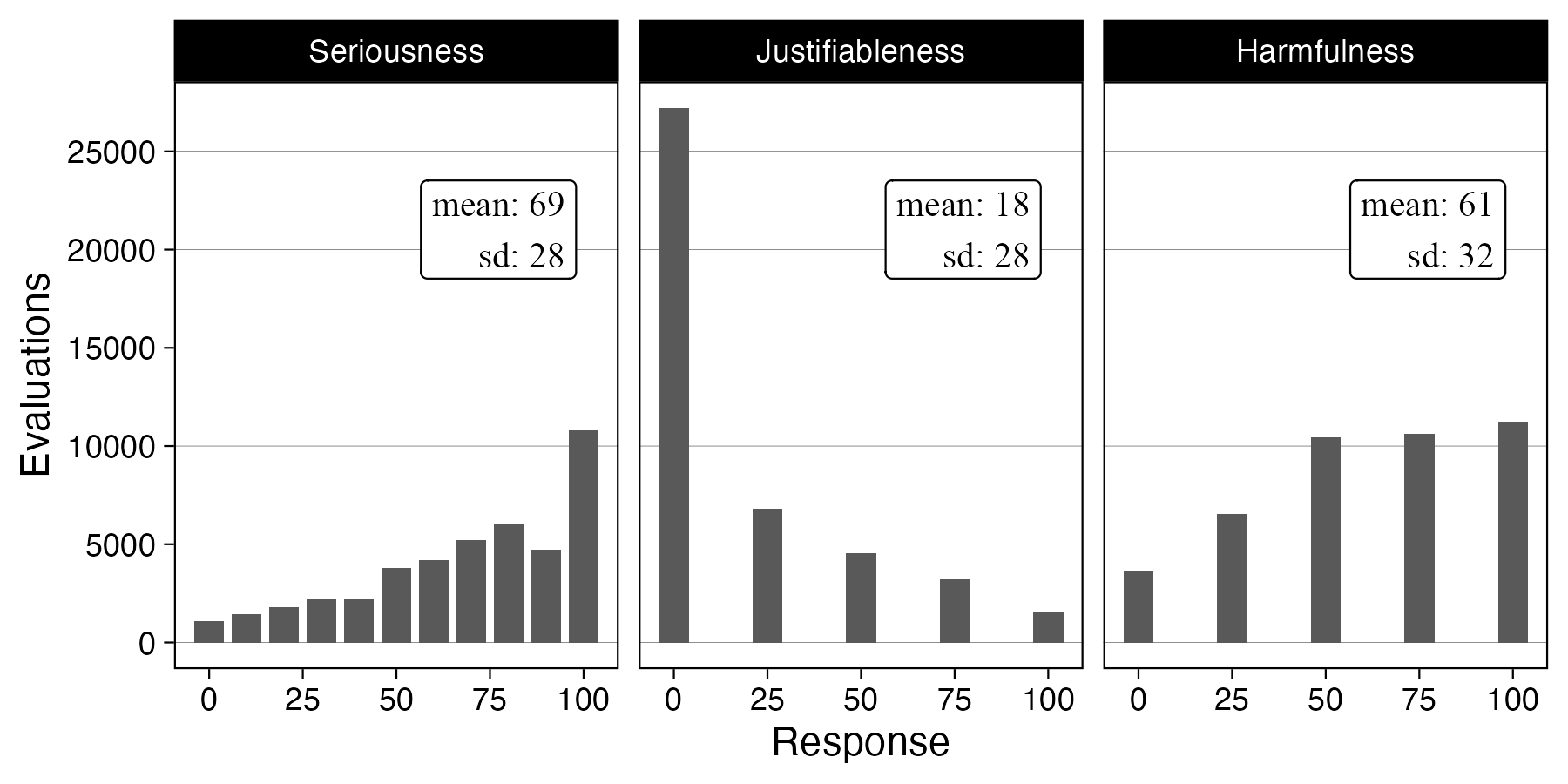
    • story evaluation: seriousness, justifiableness, harmfulness

Outcomes

  1. Perceived prevalence and personal risk

  2. Three attitudes towards harassment in politics

  3. Satisfaction with democracy

  4. Willingness to run for office in the future

  5. Index of willingness to engage in six political activities

Treatment: 5/55 harassment stories1

“I have experienced my election posters being ‘decapitated’ by unknown persons. My children, aged seven and nine, have seen this, which was very unpleasant.”

“I have experienced unpleasant advances in private messages on social media from people of all ages.”

“I have received death threats from unknown senders directed at both my little brothers and my own children.”

“There was a citizen who drove around in a car and measured how high my - and only my - posters were placed from the ground. He then reported me to the police for banners that were placed too low.”

Treatment: example


  1. 1 of 4 politician gender-age groups (randomized)
  2. Story


  1. Three evaluation questions


Repeats 5 times…
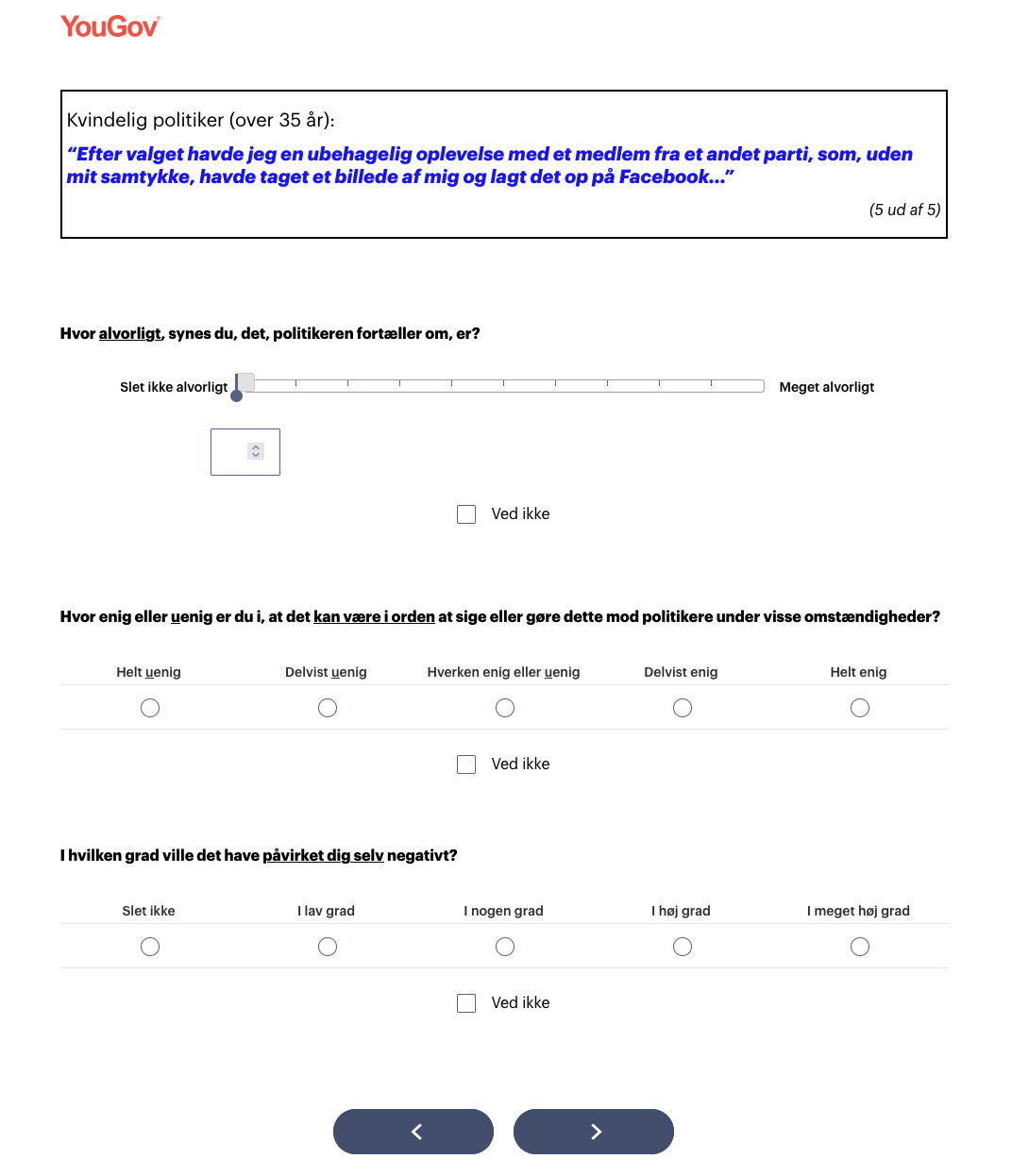
Treatment example (1 out of 5) in Danish

Story evaluations

Evaluations of 43,460 harassment stories

Results

Effects of raising awareness on harassment attitudes
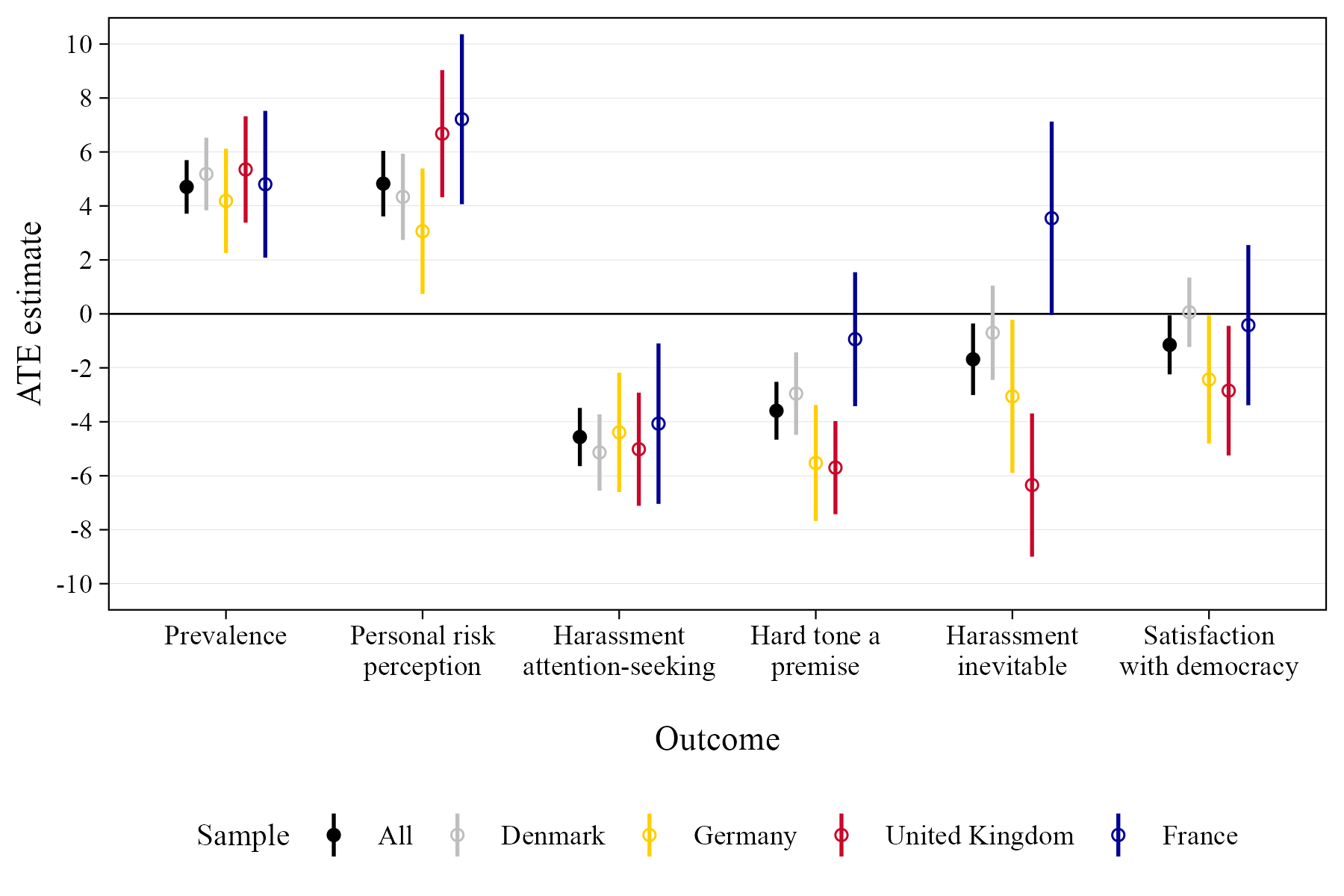
  • 4.7 %-points increase in perceived prevalence
  • 4.8 %-points increase in personal risk perception

Effects of raising awareness on harassment attitudes

  • 4.6 %-point decrease in belief that politicians’ harassment stories are about getting attention
  • 3.6 %-point decrease in belief that politicians should have known about hard tone
  • 1.7 %-point decrease in belief that harassment is inevitable (p = 0.013)
  • 1.1 %-point decrease in general satisfaction with democracy (p = 0.040)

Effects of raising awareness on political engagement

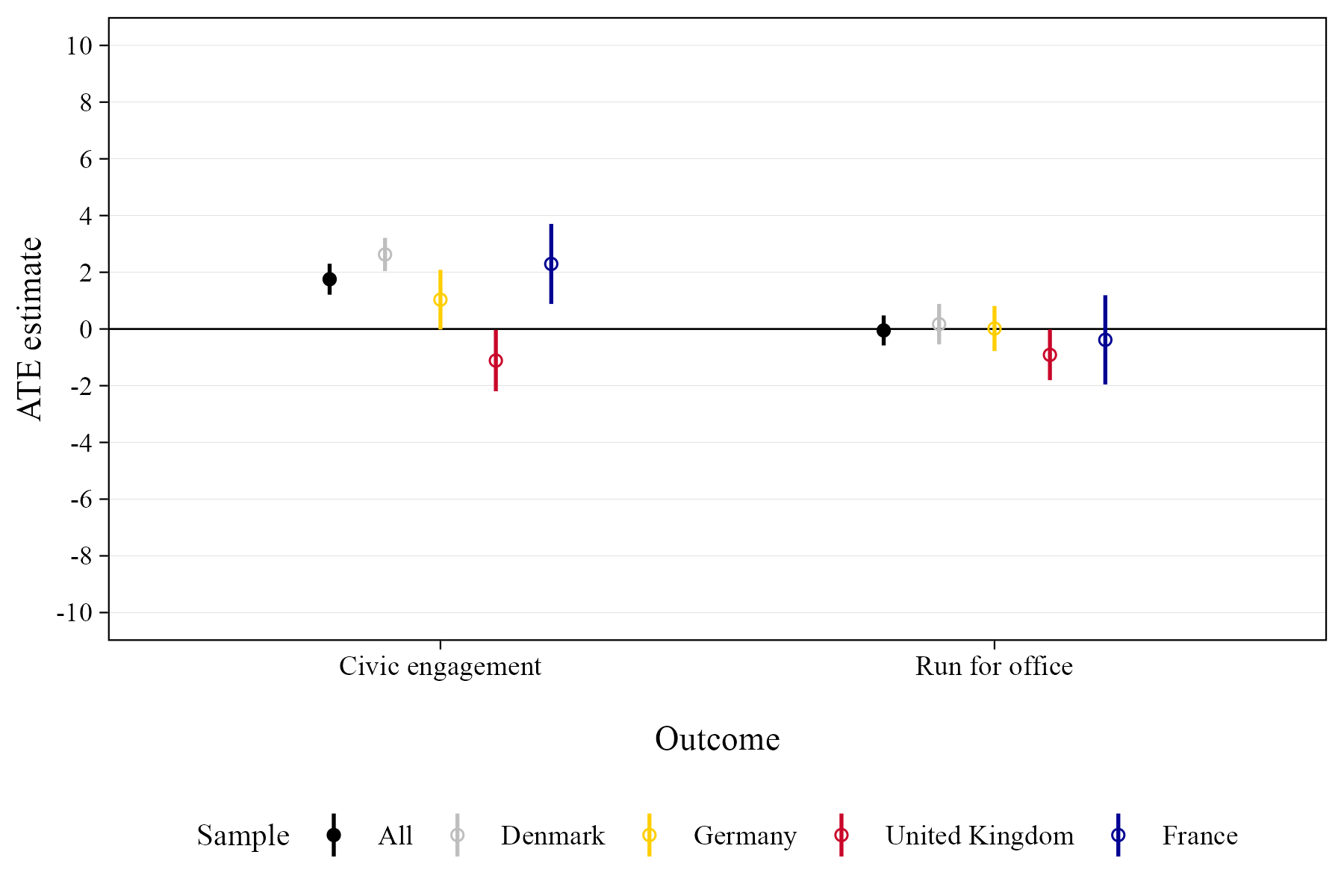
Main hypothesis: People become politically disengaged and less likely to run for office when they hear stories about harassment against politicians
Effects of raising awareness on political engagement

Main hypothesis: People become politically disengaged and less likely to run for office when they hear stories about harassment against politicians

  • No average decline in willingness to run for office (p = 0.851)
  • No decline in civic engagement
  • 1.8 %-points increase in participation in six political activities (e.g., contact politician, protest, petition, SoMe post)

Deeper dive on run for office (RFO) outcome

  • Some citizens are more likely than others to consider a political career
  • We create additive index of (1) political interest, (2) partisanship, (3) internal efficacy, and (4) external efficacy
    • we also measure pre-treatment willingness to RFO
  • We find statistically significant negative interaction with treatment (CATEs … ↓):
    • 2.0 %-points RFO decrease for ~1/6 highest index values (between subjects)
    • 3.9 %-points RFO decrease for ~1/6 highest reported pre-tests (between subjects)
    • 5.4 %-points RFO decrease for ~1/6 highest index values (within treated subjects)
    • (No conditional effects for groups with lower likelihood of running)
  • In sum, evidence that the most likely future candidates may in fact be scared away
    • but arguably still modest effect

Conclusions

  • What are the effects of raising awareness about politicians’ real harassment experiences?
  • Across four European democracies, it causes:
    • higher acknowledgement of harassment
    • lower acceptance
    • more civic engagement
    • good, but …
  • Citizens are also potential candidates of the future. Does it affect their willingness to run for office?
    • on average, no (arguably good)
    • but clear indications that it does for the more likely candidates
    • however, fairly modest (conditional) effect size: ~2-5 %-points

Thank you