Perceptions of Harassment in Politics
Survey design and preliminary findings
26. februar 2025
Purpose
- Explore how citizens react to politicians’ true stories of harassment
- Test if certain sociopolitical groups evaluate harassment as more or less serious
(also more or less justifiable and personally harmful) - Test if learning about harassment causes political disengagement and reduces willingness to run for office
Motivation
- Researchers and others often ask if differences in reported harassment experiences are due to heterogeneous sensitivity levels and/or norms
- Is it?
- If (learning about) harassment deters citizens (especially marginal groups) from entering or engaging in politics, the implications are bad
- Does it?
Design
- New survey experiment (YouGov) w/ 5,000 respondents (~3,500 so far)
- Descriptive and causal w/ preliminary results
- Preregistered
- Treatment = read and evaluate 5 random harassment stories
- random draw from 55 curated stories
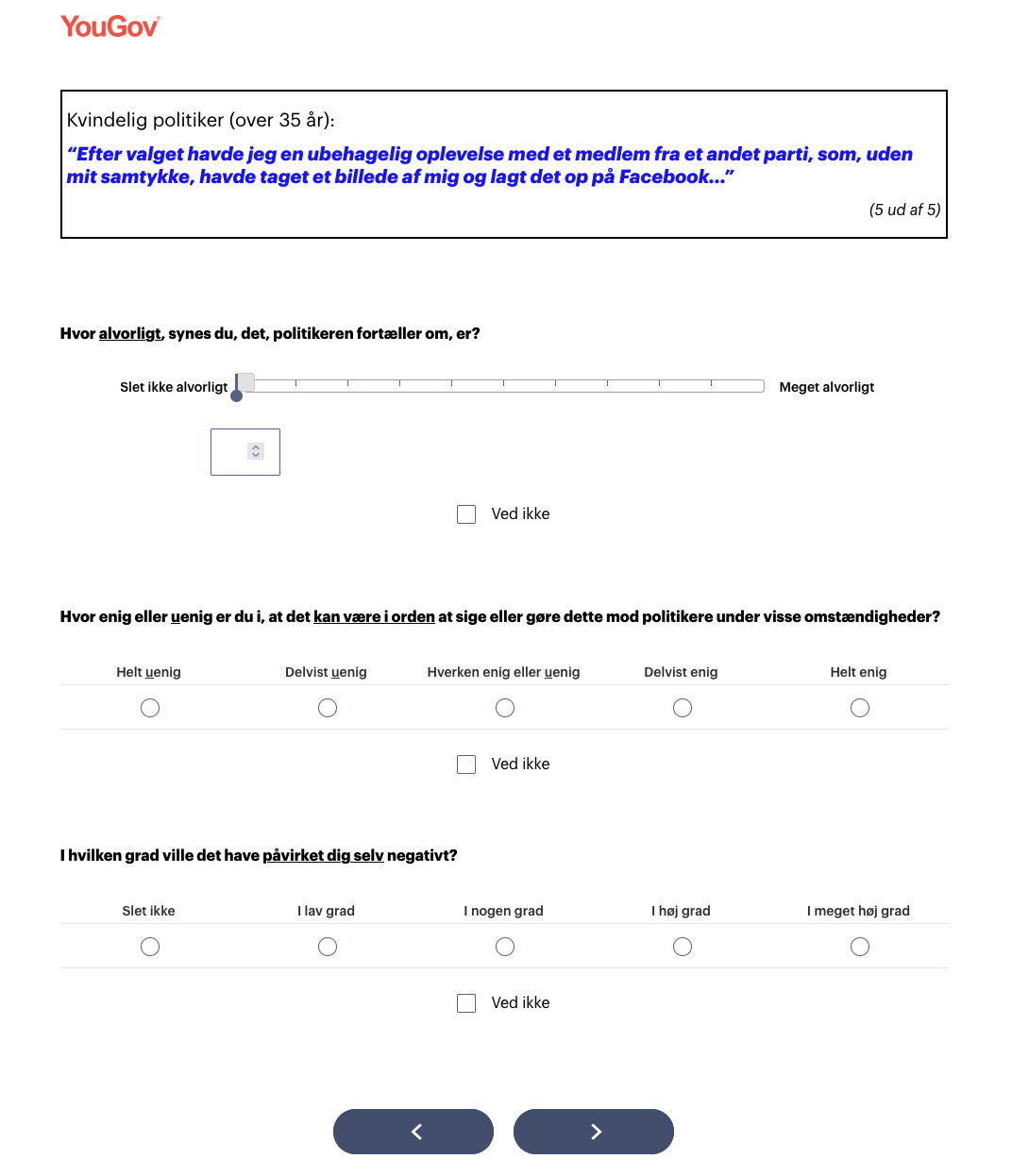
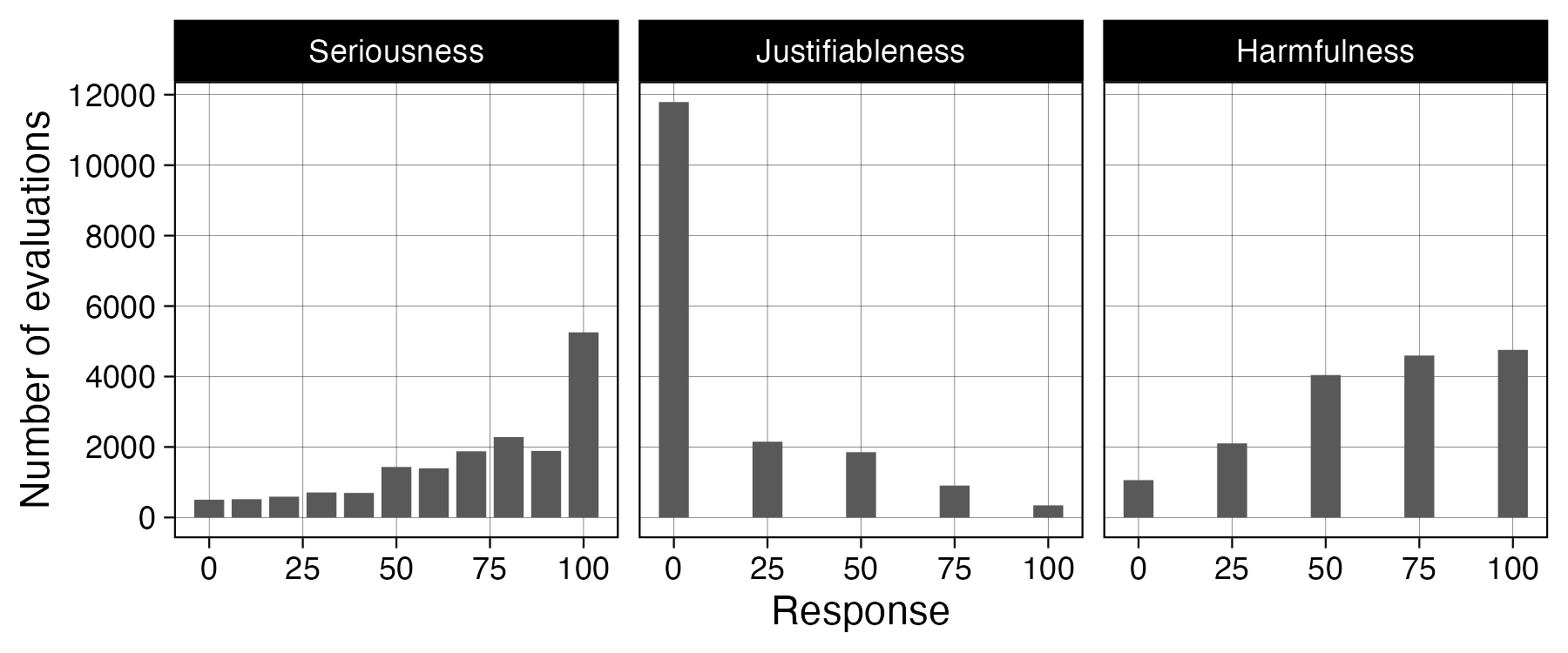
- evaluation of seriousness, justifiableness, harmfulness
- (Causal) outcomes:
- perceived prevalence (manipulation check), fear of exposure
- attitudes on harassment in politics
- likelihood of running for office, engaging in political activities
- satisfaction with democracy
- gender and age leadership attitudes
Design
55 curated harassment stories
Source: Danish 2021 municipal election candidate survey
“I have experienced my election posters being ‘decapitated’ by unknown persons. My children, aged seven and nine, have seen this, which was very unpleasant…”
“I have experienced unpleasant advances in private messages on social media from people of all ages…”
“I have been exposed to a candidate from another party starting nasty rumors about me and my candidacy”
“One person told me that my family and I were ‘going to the gas chamber’…”
3 evaluation questions
3 evaluation questions
Hypotheses and preliminary findings
We have received and partly analyzed 2/3 survey responses
Descriptive
H1: Harassment against politicians is perceived as (i) more serious, (ii) less justifiable, and (iii) more personally harmful by:
- unlikely future candidates compared to likely future candidates
- women compared to men
- young people (age 18-35) compared to older individuals (above age 35)
- people who belong to the same (age-gender) group as the target compared to people who do not
- individuals who self-identify as ideologically left-leaning compared to right-leaning individuals
Descriptive
H1: Harassment against politicians is perceived as (i) more serious, (ii) less justifiable, and (iii) more personally harmful by:
unlikely future candidates compared to likely future candidates
- No, less serious
- No
- Yes
Descriptive
H1: Harassment against politicians is perceived as (i) more serious, (ii) less justifiable, and (iii) more personally harmful by:
women compared to men
- Yes
- Yes
- Yes, much more (11%-points)
Descriptive
H1: Harassment against politicians is perceived as (i) more serious, (ii) less justifiable, and (iii) more personally harmful by:
young people (age 18-35) compared to older individuals (above age 35)
- No, less serious
- No
- No
Descriptive
H1: Harassment against politicians is perceived as (i) more serious, (ii) less justifiable, and (iii) more personally harmful by:
people who belong to the same (age-gender) group as the target compared to people who do not
- No
- No
- No
(however, yes for women: i, iii)
Descriptive
H1: Harassment against politicians is perceived as (i) more serious, (ii) less justifiable, and (iii) more personally harmful by:
individuals who self-identify as ideologically left-leaning compared to right-leaning individuals
- Yes
- Yes
- Yes
Descriptive — supplementary (respondent)
H1: Harassment against politicians is perceived as (i) more serious, (ii) less justifiable, and (iii) more personally harmful:
by conflict avoidant individuals (high conflict avoidance) compared to others
- Yes
- Yes
- Yes
Descriptive — supplementary (respondent)
H1: Harassment against politicians is perceived as (i) more serious, (ii) less justifiable, and (iii) more personally harmful:
by individuals who do not enjoy conflict (low conflict approach) compared to others
- Yes
- Yes
- Yes
Descriptive — supplementary (respondent)
H1: Harassment against politicians is perceived as (i) more serious, (ii) less justifiable, and (iii) more personally harmful:
by people who fear personal exposure to harassment in politics compared to people who do not
- Yes
- Yes
- Yes
Descriptive — supplementary (respondent)
H1: Harassment against politicians is perceived as (i) more serious, (ii) less justifiable, and (iii) more personally harmful:
by individuals who believe harassment, intimidation, and a harsh tone are integral to politics compared to individuals who do not
- Yes
- Yes
- Yes
Descriptive — supplementary (respondent)
H1: Harassment against politicians is perceived as (i) more serious, (ii) less justifiable, and (iii) more personally harmful:
by individuals who are generally satisfied with democracy compared to individuals who are dissatisfied
- Yes
- Yes
- Yes
Descriptive — supplementary (respondent)
H1: Harassment against politicians is perceived as (i) more serious, (ii) less justifiable, and (iii) more personally harmful:
by individuals who are not easily angered by contrary viewpoints
- No
- Yes
- No, less harmful
Descriptive — supplementary (target)
H1: Harassment against politicians is perceived as (i) more serious, (ii) less justifiable, and (iii) more personally harmful:
when the target is a woman compared to a man
- Yes
- Yes
- Yes
Descriptive — supplementary (target)
H1: Harassment against politicians is perceived as (i) more serious, (ii) less justifiable, and (iii) more personally harmful:
when the target is a young politician (age 18-35) compared to an older politician (above age 35)
- No
- No
- No
Descriptive — supplementary (story)
H1: Harassment against politicians is perceived as (i) more serious, (ii) less justifiable, and (iii) more personally harmful:
when the story is about physical harassment or threats
- Yes, much more (11%-points)
- Yes, much less (8%-points)
- Yes, much more (11%-points)
Descriptive — supplementary (story)
H1: Harassment against politicians is perceived as (i) more serious, (ii) less justifiable, and (iii) more personally harmful:
when the story is evaluated as more serious by others
- (Perfect correlation)
- Yes
- Yes
Descriptive — supplementary (story)
H1: Harassment against politicians is perceived as (i) more serious, (ii) less justifiable, and (iii) more personally harmful:
when the story is about sexual harassment
- No
- Yes
- No, less harmful
Descriptive — supplementary (story)
H1: Harassment against politicians is perceived as (i) more serious, (ii) less justifiable, and (iii) more personally harmful:
when the story is about harassment by someone from within the political system
- No, less serious
- No, more justifiable
- No, less harmful
Harassment from citizens/strangers is evaluated as much more problematic…
Descriptive — supplementary (story)
H1: Harassment against politicians is perceived as (i) more serious, (ii) less justifiable, and (iii) more personally harmful:
when the story is about harassment outside the social media arena
- Yes, much more (9%-points)
- Yes, much less (8%-points)
- Yes, much more (8%-points)
Causal effects of learning about harassment
Causal
H2: People become politically disengaged and less likely to run for office when they hear stories about harassment against politicians
first, a manipulation check
- 5%-points increase in guessed politician % that experience harassment (63 vs. 58%)
- 5%-points increase in fear of personal exposure
Causal
H2: People become politically disengaged and less likely to run for office when they hear stories about harassment against politicians
Attitudes on harassment in politics
- decrease in belief that harassment is inevitable
- decrease in belief that politicians should have known about hard tone
- large decrease in belief that politicians talk of harassment to get attention (4%-points)
Causal
H2: People become politically disengaged and less likely to run for office when they hear stories about harassment against politicians
Future political participation (likelihood of engaging in six activities, e.g., protest, petition, SoMe post)
- no disengagement
- instead, 3%-points increase in participation
Causal
H2: People become politically disengaged and less likely to run for office when they hear stories about harassment against politicians
Willingness to run (likelihood of running for office in future)
- no effect
Satisfaction with democracy
- no effect
Causal
H2: People become politically disengaged and less likely to run for office when they hear stories about harassment against politicians
Preference for men or young political leaders
- large decrease in preference for political leaders that are age 36+ (4%-points)
- no effect on preference for men vs. women
Conclusions
- Lots (!) of things build into survey :)
- Many descriptive expectations hold completely
- Causal hypothesis holds for many outcomes
- Important: unexpected results for likely future candidates → not the recruitment/composition story, we were planning
- citizen mobilization instead?
- (or: only good consequences of increased awareness)
- More than one paper?
- (Lots of things, yes, but also many possible extensions…)