A decade of GOTV impact
Unequal long-term effects of inducing young people to vote
EPSA 2025
June 24, 2025
Motivation
- Can GOTV efforts increase turnout and also improve participatory equality?
- Unclear what the downstream (long-term) effects are of GOTV campaigns
- requires large field experiments in the past
- highly demanding downstream data requirements
- some evidence of long-term effects,
primarily through habit (Coppock & Green 2016)
Motivation
- The (immediate) effects of GOTV campaigns have been shown to be moderated by baseline voting propensity
- (e.g., Bhatti et al. 2018; Enos et al. 2014; Hirvonen et al. 2025)
- Ongoing debate!
- Key disagreement:
- mostly low-mid (Europe) or mostly high (US)
- high exacerbates inequality
- None have studied long-term effects on participatory inequality (low, mid, high)
- We analyze conditional long-term effects of two large Danish GOTV field experiments
Data and design
- Two GOTV field experiments targeting young voters (18-29 years)
- 2013 n = 95,570 voters
- 2014 n = 153,661 voters
- total n = 249,231 voters
- sampled randomly from among vast majority of young electorate
- Combined with all available downstream turnout records
- 8 downstream elections
- 2014-2024
- local, national, EU
- 2013 total n = 710,386 turnout decisions
- 2014 total n = 1,152,522 turnout decisions
Data and design
- Panel attrition in downstream elections
- 4-44 %
- causes:
- death and migration (rare)
- non-eligibility (more common)
- lack of turnout data from entire municipalities
(common in two elections: 2014-2015)
- no influence across elections
- virtually no self-selection
- results quite robust to use of restricted/balanced panels
Data and design
- Treatment
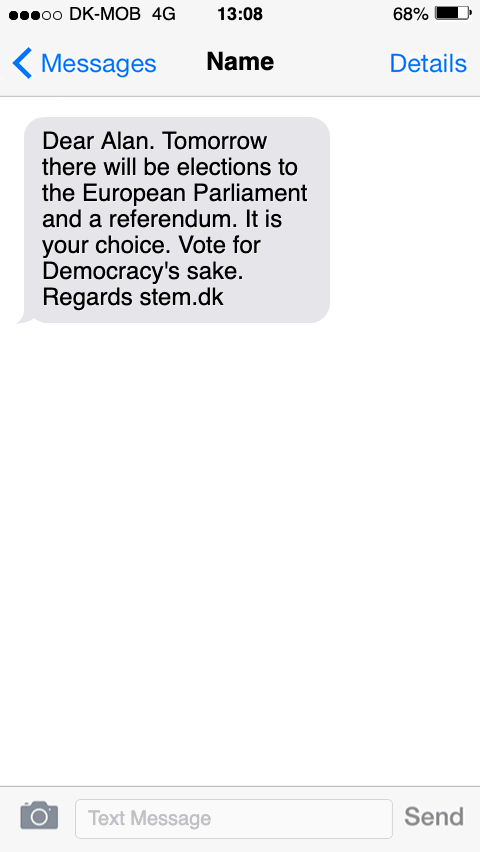
- SMS text message sent out 0-6 days before Election Day
- Short reminder about upcoming election + frame/tone variations
- Outcome
- binary turnout
- individual, validated, administrative
- basis of actual election results
Data and design
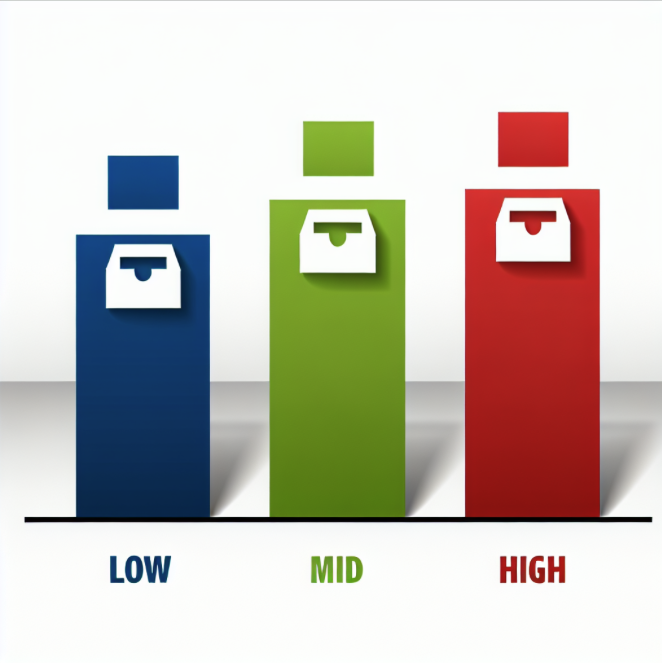
- Moderator: baseline voting propensity
- low, mid, high (~equal-sized)
- based on predicting turnout in control group
- logit model with predictors: admin sociodemographics (e.g., age, gender, social status, income, education, origin country), past turnout, same for parents
- Analysis: OLS regression
- total effects: (essentially) difference-in-means → ITTs
- election FEs, marginalizing over election
- conditional effects: interaction between treatment and voting propensity
- election FEs, marginalizing over election + voting propensity
Effects of 2013 text message GOTV campaign
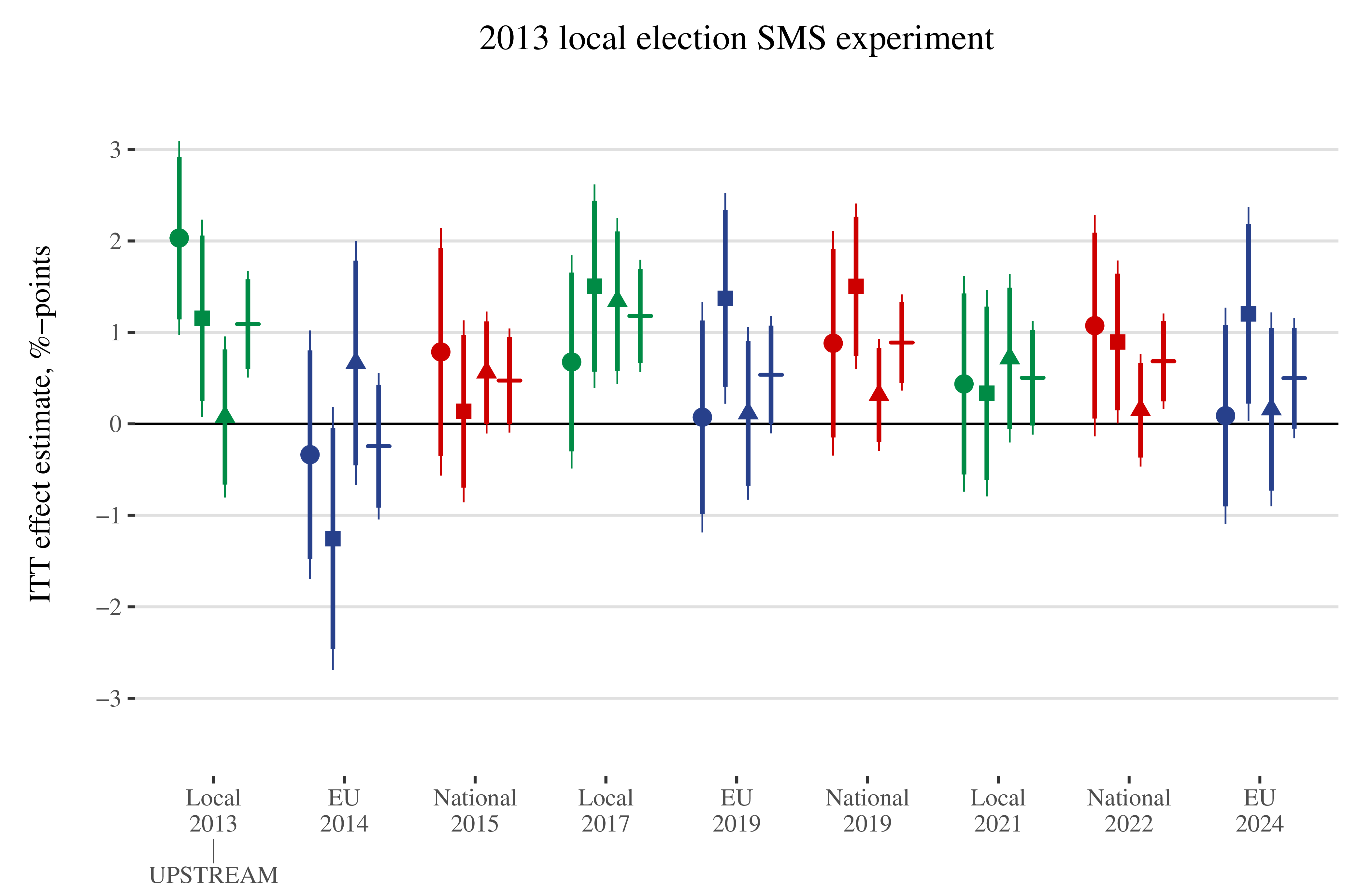
- Strong immediate effects, especially on low-propensity voters
- Different picture for downstream effects:
- low: no downstream effects
- mid: strong downstream effects across five elections
- high: downstream effects in next local election
- total: positive downstream effects in 3+ elections
- Cumulative effect = increasing participatory inequality?
(Limited) effects of 2014 text message GOTV campaign
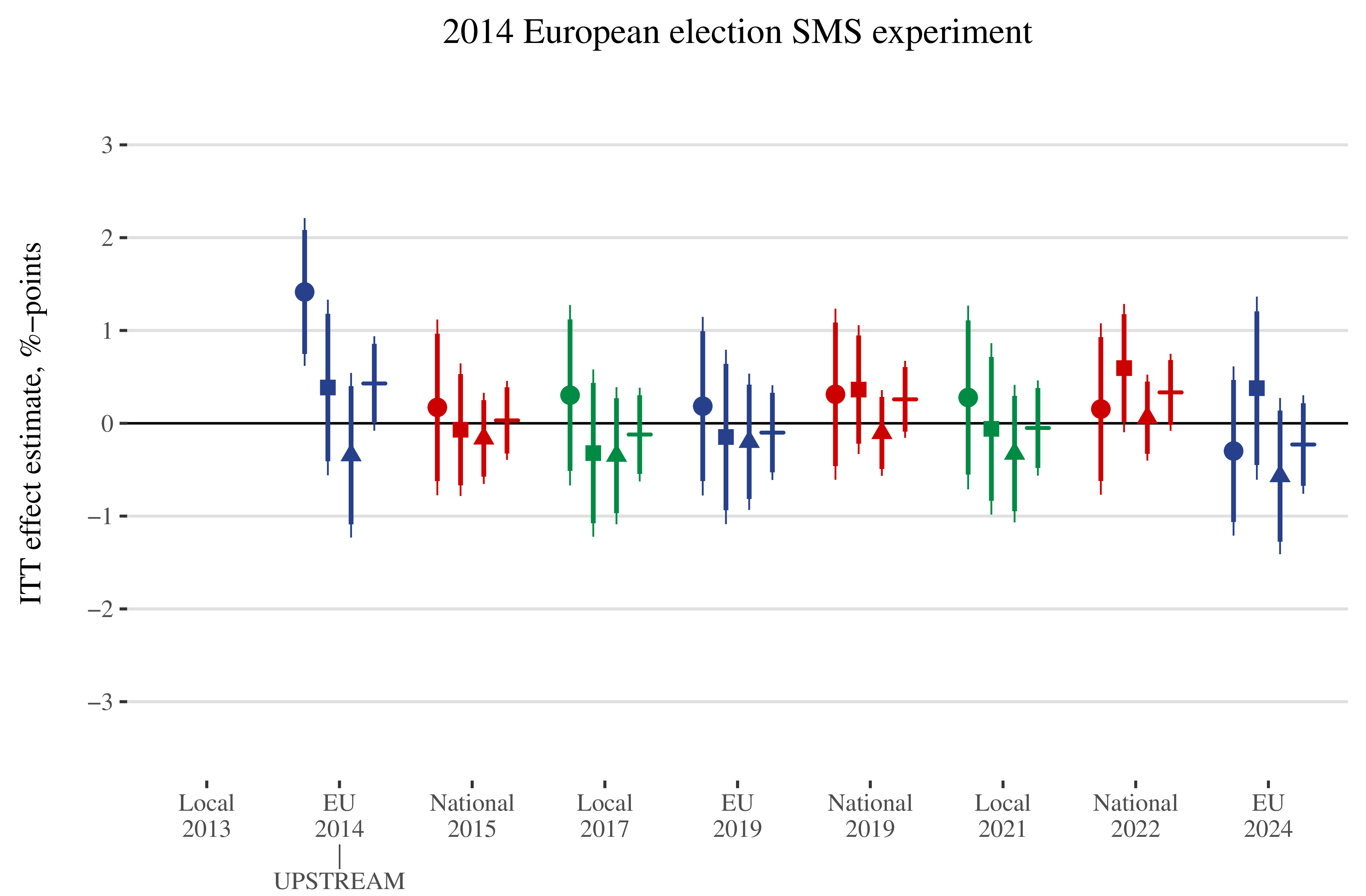
- No evidence of downstream effects
- Strong immediate effects only for low-propensity voters
- Two findings replicate:
- “stairway” of immediate effects
- no downstream effect for low
- Treatments possibly too weak, on average
- evidence of total downstream effect for particular timing-tone treatment combos
- possibly similar downstream effects conditional on voting propensity
Conclusions
- Studies of GOTV downstream effects are rare
- Studies of GOTV effects conditional on voting propensity are few
- Combination can tell us a lot about long-term benefits/risks to participatory (in)equality
- We show evidence on a decade of GOTV impact on low, mid, and high propensity voters
- immediate effects strong(est) for low-propensity voters
- but no downstream effects!
- multiple downstream effects on mid-high propensity voters
- likely, not improving equality long term – and may harm it
- Questions: (a) mechanism, (b) case + propensity definition, (c) cumulative effect